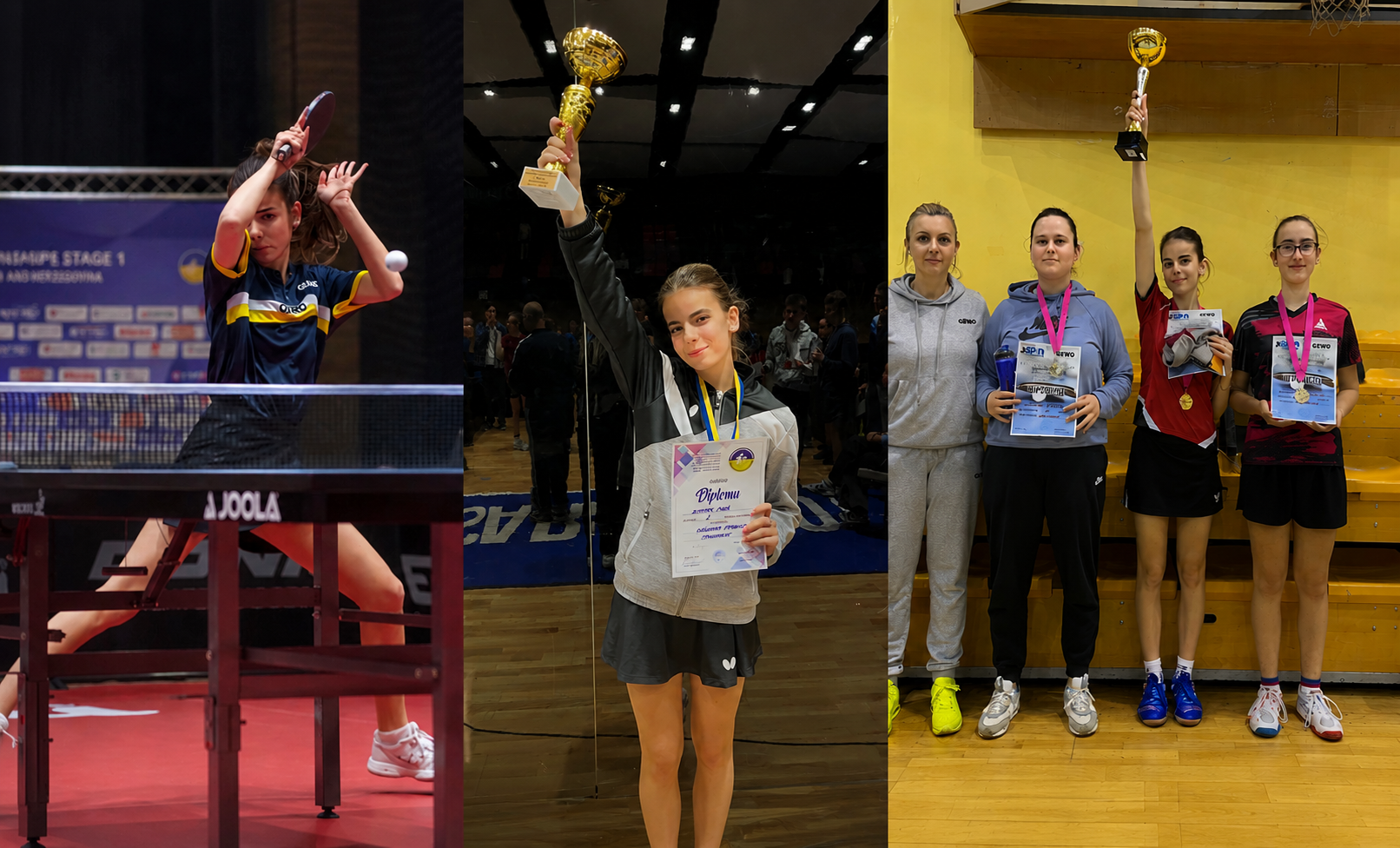
In the world of top-level sports, we often hear about sacrifice, but we rarely have the opportunity to meet someone who balances demanding academic obligations and podium finishes with such ease and a smile. In this month’s interview, we take you into the world of speed, incredible reflexes, and steel discipline. We spoke with Ajna Zlotrg, a student who recently won an excellent second and third place at the national table tennis championship. For our newsletter, Ajna reveals how she inherited her love for this sport from her family, how she finds focus in key moments of a match, and why she believes that table tennis teaches us the most important life lessons.
- When did you start playing table tennis and what attracted you most to this sport?
I have been involved in this sport for many years. I started training in 2013 as an eight-year-old. Almost all members of my family were involved in table tennis at some point in their lives, some more intensively and others recreationally, but the fact is that it was a sport everyone loved. Because of that, I developed an interest in table tennis myself. In addition, this is a very fast and dynamic sport that requires concentration and focus, develops reflexes, and trains not only the body but also the mind.
- How do you manage to balance academic obligations with training sessions and competitions?
I have no problem when it comes to balancing table tennis with academic obligations. Honestly, I no longer even remember what my routine looked like without training sessions and competitions. I am used to having a full day and, in addition to university obligations, having training sessions, while weekends are mostly reserved for competitions. It has become my everyday life. I believe that with good organization and discipline, everything can be achieved.
- Was there a particular moment during competition that you will remember especially?
Winning the national junior championship in 2024 is definitely a moment that I will always remember. I played the final match against a good friend of mine, the score was 2:2 in sets, and the deciding set was very exciting and uncertain. I will never forget the feeling of happiness and relief after winning the decisive point. It was a mentally very difficult match, but in the end, I managed to come out of that battle as the winner.
- What brings you the most joy in table tennis – victories, the atmosphere at competitions, or something else?
I have always been the type of person who enjoys the atmosphere the most. My best friends and my dearest memories are connected to table tennis, and that is why I love this sport so much. Of course, victories are also a very important factor, and I always strive for them, but even when defeat or disappointment comes, I enjoy the companionship and sporting atmosphere that this sport brings.
- What advice would you give to young people who want to start training in table tennis or become more seriously involved in sports?
I would like to encourage young people to train in table tennis because I believe this sport deserves much more attention than it currently receives. It is a sport that develops not only physical but also mental abilities, because it requires constant focus, concentration, and thinking, especially if you practice it at a more professional level. But even recreationally, table tennis is an excellent option for physical activity and can be very interesting. In general, every sport is an opportunity to build yourself as a person, develop discipline, and get to know yourself – how you react after defeat, how you deal with anger and happiness, how persistent and determined you are. My advice to young people would be to try to persevere in training even when it becomes difficult, because it is precisely through that process that we build ourselves the most.
- If you could single out one thing that sport has taught you, what would it be?
Among the most important things that sport has taught me are work, order, and discipline – that a great deal of effort and time is needed to achieve what you want. But perhaps it has also taught me something that people would not expect as an answer. Through table tennis, I realized how true the saying is that hope dies last. Countless times I have experienced, and also seen in others, that people do not give up even when a situation seems almost impossible. Of course, one should always fight until the end, but there are moments when the chances of victory are almost non-existent, when the opponent is much better, or when you are losing by a large margin. Nevertheless, until the very last point there is always that hope that a comeback can happen. Perhaps that is a somewhat unusual thing for me to single out, but I consider it one of the most beautiful lessons that sport has given me.